
Tennessee Center for the Study and Treatment of Dyslexia
Definition of Dyslexia
2025 Revised Definition of Dyslexia
In October 2025, the International Dyslexia Association shared an updated definition of dyslexia to reflect current understandings based on decades of scientific evidence and lived experiences of individuals with dyslexia. The 2025 revised definition can be found below.
Dyslexia is a specific learning disability characterized by difficulties in word reading and/or spelling that involve accuracy, speed, or both and vary depending on the orthography. These difficulties occur along a continuum of severity and persist even with instruction that is effective for the individual’s peers. The causes of dyslexia are complex and involve combinations of genetic, neurobiological, and environmental influences that interact throughout development. Underlying difficulties with phonological and morphological processing are common but not universal, and early oral language weaknesses often foreshadow literacy challenges. Secondary consequences include reading comprehension problems and reduced reading and writing experience that can impede growth in language, knowledge, written expression, and overall academic achievement. Psychological well-being and employment opportunities also may be affected. Although identification and targeted instruction are important at any age, language and literacy support before and during the early years of education is particularly effective. (International Dyslexia Association, October 2025)
To learn about the process that led to this revised definition, please visit IDA’s website.
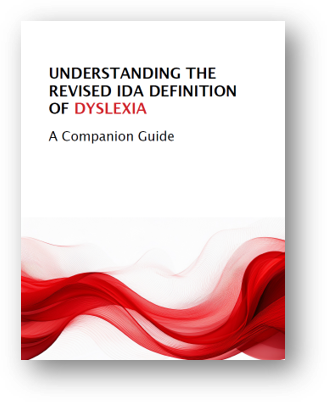
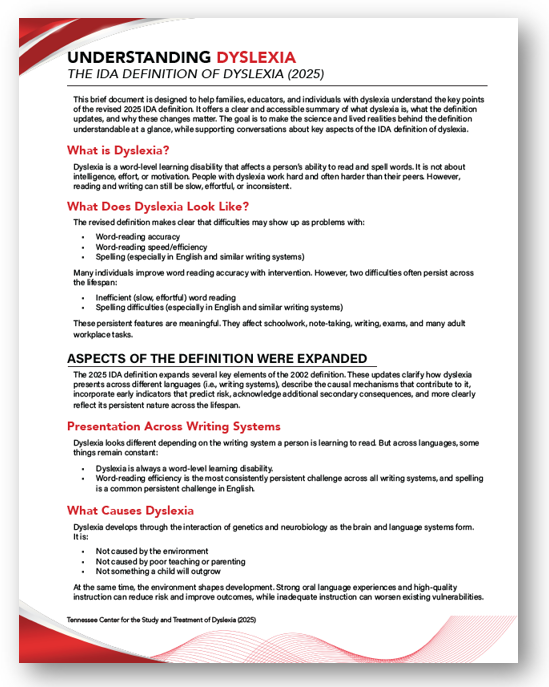
Dr. Odegard, Katherine Davis Murfree Chair of Excellence in Dyslexic Studies and Professor of Psychology at MTSU, has authored two new documents to help practitioners, parents, and policymakers unpack and understand the IDA’s 2025 revised definition of dyslexia. As a member of the Steering Committee, Dr. Odegard played an instrumental role in crafting the 2025 definition.
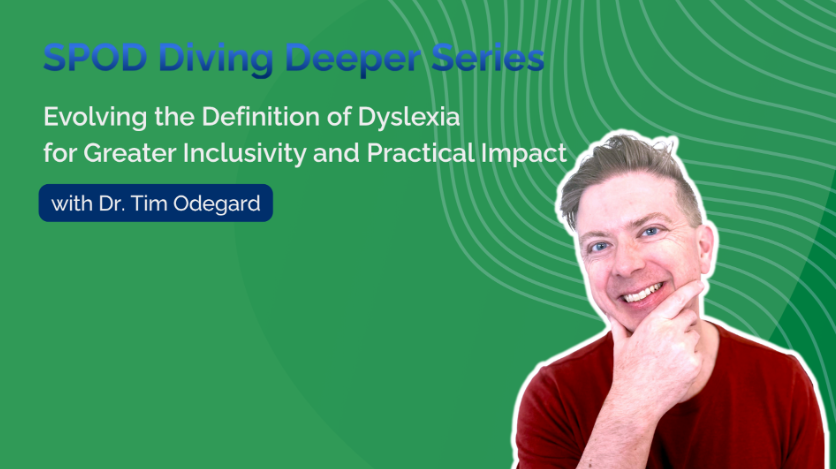
On November 5, 2025, Dr. Odegard led a webinar for Learning Ally to unpack the revised IDA definition of dyslexia. In the webinar, Tim discussed how educators can align practices with current scientific consensus and offered suggestions for effectively advocating for learners with dyslexia. Click on the image below to be taken to a recording of this presentation. Please note: The recording is available for free viewing after registering with Learning Ally.
2002 Consensus Definition of Dyslexia
Note: In 2016, with its passage of T.C.A. § 49-1-229, the state of Tennessee adopted the IDA’s previous definition of dyslexia, crafted in 2002, which can be found below. The 2002 definition explicitly defines dyslexia as a specific learning disability. Any child identified with a specific learning disability in basic reading or a specific learning disability in reading fluency has been identified as having dyslexia under current federal and state laws.
Dyslexia is a specific learning disability that is neurobiological in origin. It is characterized by difficulties with accurate and/or fluent word recognition and by poor spelling and decoding abilities. These difficulties typically result from a deficit in the phonological component of language that is often unexpected in relation to other cognitive abilities and the provision of effective classroom instruction. Secondary consequences may include problems in reading comprehension and reduced reading experience that can impede growth of vocabulary and background knowledge.
International Dyslexia Association (IDA, 2002).
“Characteristics of dyslexia” is a more inclusive term that does not require that a student be identified with a specific learning disability. The term is adopted in Tennessee (T.C.A. § 49-1-229). It was adopted to ensure that students who struggle with word reading skills in any grade (K – 12) receive appropriate direct systematic instruction to teach them to read words accurately and / or fluently in support of comprehending written language.
Both terms “dyslexia” and “characteristics of dyslexia” apply to public schools in Tennessee in accordance with Tennessee T.C.A. § 49-1-229.